William Blake was an exceedingly imaginative and eclectic artist and poet with a deeply religious and moralistic streak.
Blake’s work is at once visually fanciful and socially germane. In his drawings, watercolors, and prints, the artist developed a diverse personal mythology that frequently served as a critique of contemporary politics and culture. Throughout his life, Blake was a social outsider who struggled with poverty and was openly mocked by art world critics. Since his death, however, he has come to be recognized as a visionary.
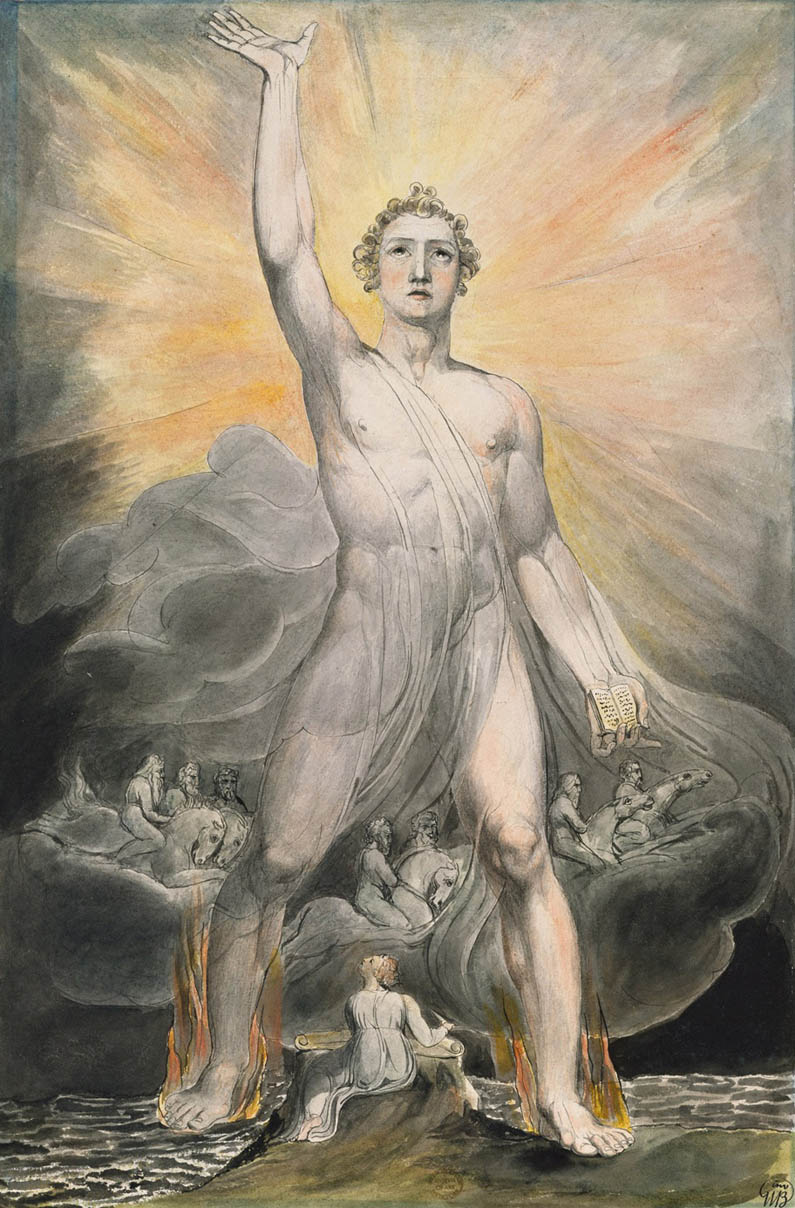
Blake’s Angel of the Revelation represents an episode from the Book of Revelation in which Saint John describes the visions he experienced on the island of Patmos. In Blake’s image, it is easy to miss the small figure of John, shown from the back, at bottom center. Rather, it is the monumental angel, who stretches across the image, top to bottom, that demands our attention. Despite his muscular corporeal form, the angel appears luminous and transcendent. His arm and eyes raised to the heavens, the angel’s upper body is surrounded by a bright corona of light that contrasts with the dark and ominous scene below. Here, in the lower half of the work, the translucent cloth draped over the angel’s body seems to billow out around him, creating a smoky cloud out of which the rest of John’s vision emerges.
Many of the details in the image interpret the biblical passage (Revelation 10:1–7) rather literally. The text, for example, describes the angel as having legs “like fiery pillars” and indicates that he had one foot on land and the other on the sea. Elsewhere, however, Blake takes certain liberties. The rainbow John puts over the head of the angel is transformed into an explosion of light, and the vague “seven thunders” of which the author writes are here personified as seven ghostly horsemen. Blake, furthermore, collapses time, representing simultaneously the moment the angel “gave a loud shout like the roar of a lion,” eliciting a response from the seven thunders, and the following moment when he raised his hand in an oath to heaven.
Such apocalyptic subject matter was extremely attractive to Blake, who was skeptical of the pure reason espoused by Enlightenment philosophy, critical of its atheistic tendencies, and disheartened by the threat rationalism posed to creativity. The visionary heroism of this angel contrasts dramatically with Blake’s famous 1795 image of the scientist Isaac Newton, whom the artist depicts hunched over uncomfortably and facing empty darkness.